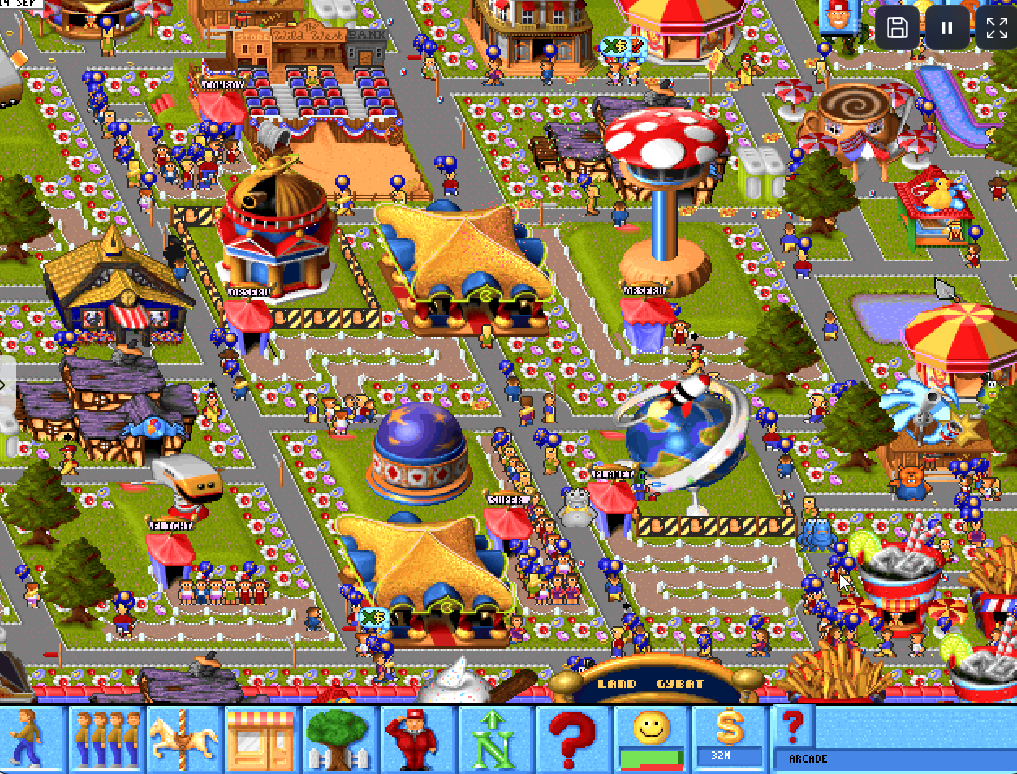
I recently re-discovered and started playing a computer game from 1994.
Theme Park.
I hadn’t played it in decades, but within about five minutes of starting a new game, I remembered why I liked it so much as a kid. You start with $150,000 and, if you want it, another $200,000 in borrowing power. Then you’re handed a piece of land and told, essentially, to go build yourself a theme park.
There isn’t much of a tutorial beyond that. You figure it out.
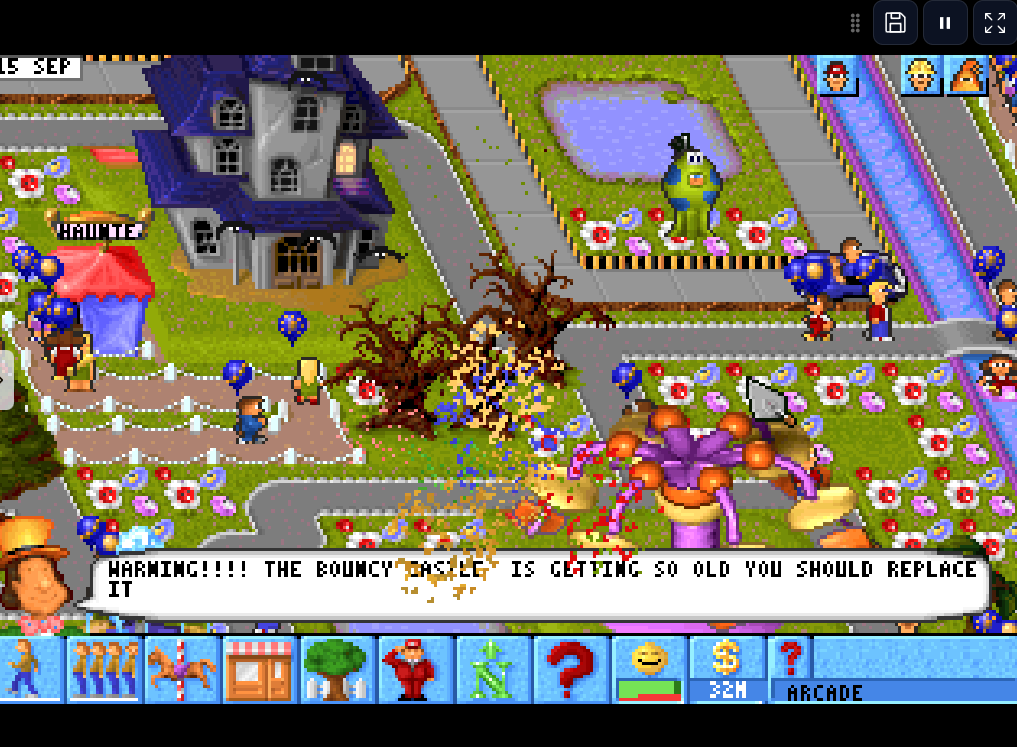
You buy your first ride, find somewhere to put it, hire somebody to operate and maintain it, build a food stand, set your prices and then watch a bunch of little people wander around your park deciding whether or not they’re having a good time. If you do things reasonably well, they spend money. If you do things badly, they complain, rides break down, employees become unhappy and the whole thing starts eating cash.
It’s a remarkably good little business simulator, especially considering it came out in 1994.
I loved it as a kid, and one of the things I’ve found interesting about playing it again now is realizing that I actually understood more of the business than I gave myself credit for. I understood that revenue needed to exceed expenses. I understood that employees cost money and rides cost money. I understood that if you charged too much for something, people wouldn’t buy it, and if you charged too little, you were leaving money on the table. I understood that popular rides were valuable because they brought people into the park and kept them there.
The basic economics weren’t particularly difficult.
What I didn’t understand was everything happening underneath them.
I didn’t know anything about capital allocation. I didn’t have a concept of leverage or opportunity cost. I certainly wasn’t thinking about whether spending money today could create a much larger return three years from now. I just knew that sometimes you had to spend money to make money, which, as it turns out, is about as far as most ten-year-olds need to get into corporate finance.
The land itself was another part of the game I’d mostly forgotten. You don’t simply get a piece of property for free and forget about it. There are land taxes to deal with, and eventually you can buy the land outright. Early in the game, that creates an interesting tradeoff because cash is scarce. You’ve got your $150,000, potentially another $200,000 in debt, and a whole park to build. Do you keep that money available to invest in rides and infrastructure, or do you put a significant chunk of it into owning the land underneath the business?
As the park grows and you accumulate more money, the decision changes. What felt like an enormous expense early in the game becomes a relatively obvious investment later. The economics change because your balance sheet has changed.
Again, I didn’t think about any of this when I was a kid. I just wanted more rides.
Then there’s the stock market.
This is the part that really caught me by surprise when I started playing again.
Theme Park has an entire stock-trading component built into it. You can buy shares in competing parks, collect dividends and trade the shares as their values change. It’s almost comically sophisticated for a game where you’re also worrying about whether your employees are keeping the bathrooms clean.
As a kid, I treated the stock market as a side feature. It was something else to click on once in a while.
Playing it now, I realized that it changes the entire way you think about the game.
The obvious way to make money is to run a good theme park. Get people through the gates, give them things to spend money on, keep the rides operating, control your costs and gradually make the park more profitable. That’s the operating business, and it’s the part most people naturally focus on.
But once you’ve accumulated some money, you have another decision to make: what are you going to do with it?
You can keep putting it into the park. You can buy land. You can build more rides. You can hire more employees. Or you can put some of that capital into the stock market, where it can generate dividends and potentially appreciate in value.
That’s where the game starts to feel less like a theme park simulator and more like a surprisingly decent lesson in capital allocation.
I started playing again with that $150,000 and eventually worked my way up to about $32 million.
At some point, the numbers stopped feeling real. The difference between spending $100,000 and $500,000 wasn’t quite as interesting anymore. I could afford the rides. I could afford the employees. I could afford to improve the park. I could buy the land. I could continue trading stocks.
The game had changed.
When you have $150,000, you’re constantly asking what you can afford.
When you have $32 million, you’re asking what you should do with it.
That’s a fundamentally different problem.
And I was putting a lot of that money back into the park. Better rides, more employees, more infrastructure. The goal wasn’t simply to accumulate the biggest possible pile of cash. Once you have enough capital, the more interesting question becomes what that capital can produce when you put it back to work.
I’d gotten to the point where I felt like I’d pretty much figured out the game.
I’d learned how to operate the park. I’d figured out the land. I’d figured out the stock market. I’d built and sold parks and carried the accumulated wealth into the next one. I’d gone from $150,000 to $32 million.
Then I learned about the closed-loop circuit.
And that was when I realized I hadn’t actually figured out the game at all.
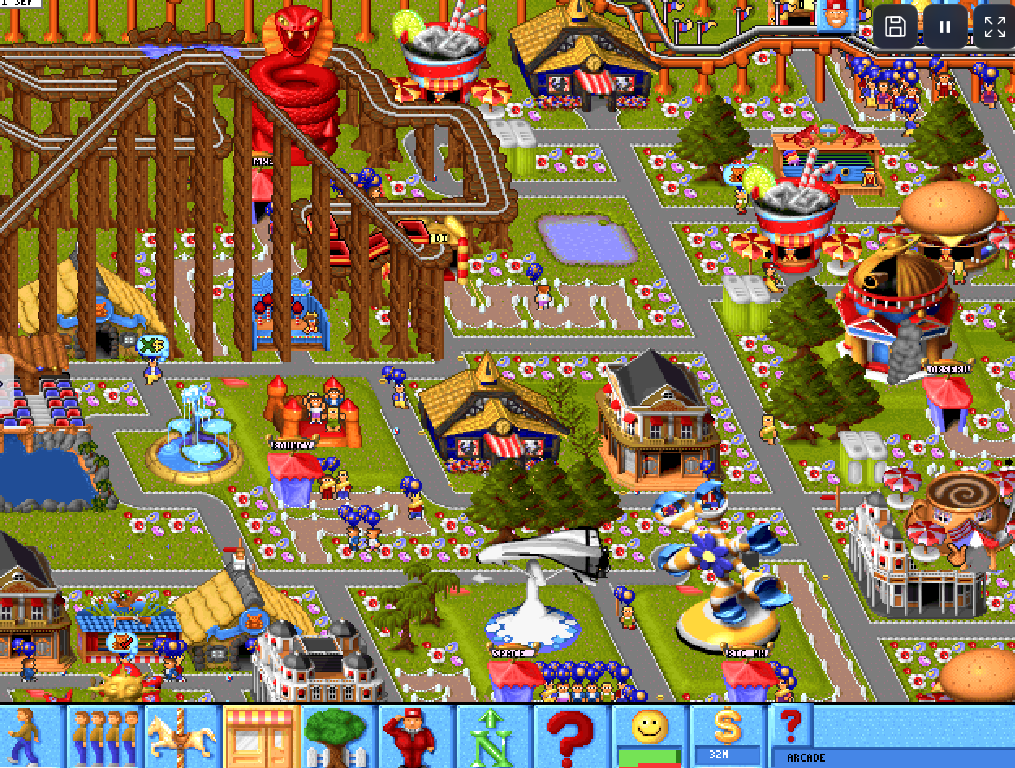
The closed-loop design can dramatically increase the number of guests your park can handle because of the way it moves people through the park. Suddenly, all of the money I’d accumulated wasn’t necessarily the most important thing.
I’d run into a capacity problem.
That was a funny realization because I’d spent all this time thinking about how to make the park more profitable, and here was this completely different problem sitting underneath everything else. It didn’t matter how much money I had if the physical design of the park limited how many people could efficiently move through it.
The bottleneck wasn’t capital anymore.
It was capacity.
And that may be the part of the game I appreciate most now.
When I was a kid, I thought Theme Park was about building rides. Looking at it as an adult, it’s really about building a system. The rides are one part of the system. The employees are another. The land is another. The customers are another. The money is another. The stock market sits outside the park and gives you another way to deploy the capital you’ve accumulated.
And every time you think you’ve solved one problem, you eventually discover another constraint.
That’s actually pretty close to how business works.
You can spend years trying to generate more demand, only to discover that your operation can’t handle the demand you already have. You can spend more money on growth when the real problem is the way the business is structured. You can accumulate capital and then discover that knowing where to deploy it is much harder than making it in the first place.
The game doesn’t explain any of that.
It just lets you run into the problems yourself.
That’s probably why it still holds up.
As a kid, I understood the immediate objective. Make money, build a better park, buy better rides, make more money.
I didn’t have the vocabulary for the bigger ideas. I didn’t know I was making decisions about debt, real estate, investment, reinvestment, capital allocation or operating capacity. I certainly didn’t know that sometimes the biggest opportunity isn’t finding a way to make more money, but finding the constraint that’s preventing the money you already have from doing more work.
I just knew I wanted to build a really good theme park.
And now, thirty-two years after the game was released, I’m sitting here with $32 million in virtual wealth, redesigning my amusement park because I’ve discovered that I’ve got a traffic problem.
Which is probably about as good a reminder as any that sometimes the most interesting lessons are the ones you didn’t realize you were learning.
If you want to experience the wonderfully weird business simulation yourself, the original game can actually be played in a browser here: