There’s a pattern in the market that doesn’t get talked about enough. Big brands rarely fail in dramatic fashion. They don’t explode… they fade. Slowly, quietly, and then one day they’re just not part of the conversation anymore.
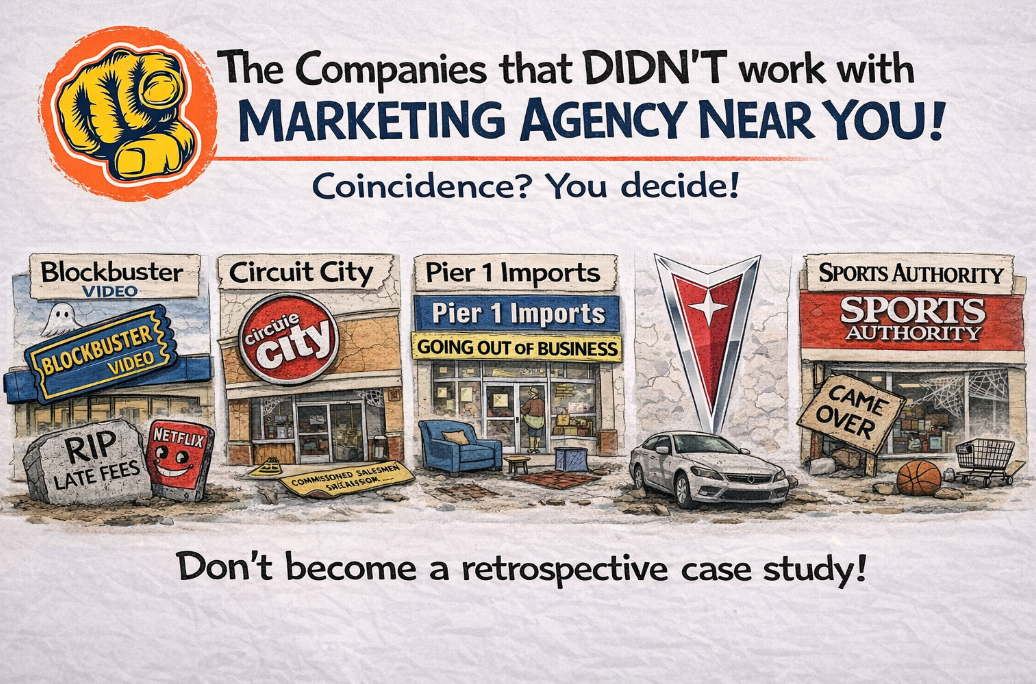
Blockbuster. Circuit City. Pier 1 Imports. Pontiac. Rite Aid. Sports Authority.
At one point, each of these brands dominated their category. They had recognition, reach, and momentum most businesses never achieve. And still, they stalled out.
What makes this interesting isn’t what they lost. It’s what they had and couldn’t keep.
The common thread isn’t bad luck. It’s what success does to decision-making. When something works for long enough, it starts to feel permanent. Recognition starts to feel like security. It isn’t. It’s temporary, and it has to be reinforced every time the market shifts.
Don’t Double Down on Yesterday’s Winning Hand
At its peak, Blockbuster didn’t just dominate its category, it defined it. The experience, the locations, even the ritual of going there on a Friday night… it all worked. That success is exactly what made it vulnerable.
When streaming entered the market, the shift wasn’t subtle. Convenience had clearly won. But instead of rethinking how they delivered value, Blockbuster protected the model that made them successful in the first place. They leaned into late fees and physical distribution as if those were still strengths, when in reality they were becoming liabilities.
They didn’t lose because they lacked resources. They lost because they misread the moment and chose to defend the past instead of adapting to the future.
The High Cost of Cutting the Wrong Corners
Circuit City is a different kind of failure. On the surface, their decision looked logical. They removed commissioned sales staff to reduce costs and improve efficiency.
What they didn’t account for was that those salespeople were the experience. They were the mechanism that helped customers navigate complex purchases. Once that layer was removed, the stores became transactional in the worst way possible… confusing, impersonal, and easy to walk out of.
Cost-cutting isn’t inherently a problem, but when you remove the part of the business that actually drives conversion, you’re not optimizing… you’re dismantling.
Vibes Don’t Always Equal Transactions
Pier 1 Imports built a brand almost entirely on atmosphere. It felt curated, immersive, and distinct. People enjoyed being there, which is something most retailers struggle to achieve.
The issue was that the experience didn’t translate into consistent purchasing behavior. Customers came in without a clear intent, and the brand didn’t evolve to meet a more utility-driven buyer. As consumer expectations shifted toward convenience and clarity, the gap between “feels good” and “makes me buy” became too large.
Branding can attract attention, but without a clear path to transaction, it can’t sustain growth on its own.
The Danger of the Quiet Fade
Not every brand fails in a visible way. Some simply lose relevance over time.
Pontiac once had a strong identity built around performance and personality. Over time, that positioning eroded. The differentiation blurred, and eventually the brand stopped standing for anything specific.
Rite Aid represents a different version of the same issue. It still exists, but without momentum. The experience hasn’t meaningfully evolved, and there’s nothing pulling the customer back in. When a brand maintains presence without progress, it becomes forgettable.
This kind of decline is harder to detect because there’s no clear breaking point. It’s just a gradual loss of attention and relevance.
The Myth of Permanent Positioning
Sports Authority is a good example of how naming and positioning can create a false sense of security. Owning a category in name doesn’t mean you own it in practice.
As ecommerce reshaped retail, the expectations around selection, pricing, and convenience changed. The brand didn’t keep pace with that shift. The authority they once held wasn’t reinforced, and eventually it was replaced by competitors who adapted faster.
Positioning isn’t static. It has to be maintained and re-earned as the market evolves.
Marketing as Infrastructure, Not an Event
What connects all of these examples is not a lack of effort, but a lack of structure. These companies weren’t inactive. They were just operating without a system that allowed them to consistently adapt.
Without a framework for testing, iterating, and responding to real-time behavior, decisions become reactive or, worse, stagnant. Growth turns into guesswork, and guesswork doesn’t scale well.
Marketing works best when it’s treated as infrastructure. Something that runs continuously and evolves with the audience, rather than something that gets turned on when results dip.
A simple way to think about it is through a loop: launch new ideas, operate them consistently, optimize based on data, and then build on what works. That cycle is what keeps a brand moving forward instead of standing still.
Conclusion: How Will You Show Up?
None of these brands failed because they stopped trying. They failed because they stopped evolving in the right ways. The market changed, the customer changed, and their approach didn’t keep up.
That’s the real risk. Not failure in a single moment, but the slow drift that happens when adaptation stops being a priority.
The question isn’t whether the market will shift again. It will. The question is whether your brand is built to move with it, or if it’s relying on past success to carry it forward.