It’s Time to Talk About What Actually Matters.
Is prompting dying?
Maybe. Maybe not. But I think overly engineered prompts, the kind we’ve spent the last few years creating, tweaking, collecting, and selling, are becoming a much less important tool.
When ChatGPT first hit the scene, prompting was a big deal. We were all figuring out how to communicate with this new technology. The difference between asking a vague question and giving it detailed instructions could make a pretty dramatic difference in the results. So naturally, an entire industry popped up around it. Prompt libraries. Prompt courses. Prompt engineers. Prompt marketplaces. People selling collections of hundreds of prompts for just about everything imaginable.
And for a while, that made sense. We were learning. We were experimenting. We were figuring out what AI could do and how to get better results from it.
But the technology has changed. The tools have changed. What AI is capable of doing has changed dramatically. Yet a lot of people are still approaching it like it’s 2022, spending an enormous amount of time trying to find the perfect combination of words to get the perfect result.
I think we’re missing the bigger picture.
The real skills are becoming much more about vision, context, abilities, skills, and outcomes. Knowing what you want to accomplish, giving AI the context to understand the situation, knowing what it can actually do, building repeatable processes, and focusing on the process before the result.
And perhaps most importantly, understanding WHY you’re doing something before confidently prompting AI to do it.
Think about how many people jump straight into AI and ask it to write an ad, build a marketing strategy, create a sales funnel, analyze a business, or automate a process. The request might sound perfectly reasonable. The output might even look impressive. But do they actually understand the process they’re asking AI to perform?
Do you understand why a particular ad works? What makes a sales funnel effective? What information is needed to make a meaningful analysis? What the workflow is supposed to accomplish? Where the bottlenecks are? What a successful outcome actually looks like?
Because if you don’t understand the process, you’re not really directing AI. You’re just hoping it knows what you mean.
And AI can confidently give you something that looks impressive, sounds intelligent, and is completely wrong for what you actually need.
Learn the WHY of a process before confidently prompting it, and the quality and power of your output can increase 100x. Not because you discovered some magical prompt, but because you understand what you’re asking AI to do in the first place.
That’s a completely different approach.
Instead of collecting 47 prompts to write a Facebook post, learn how to create effective Facebook content. Understand your audience, the objective, the message, the offer, the platform, and what you’re trying to get somebody to do. Then use AI to help execute that process. The prompt becomes a much smaller piece of the equation.
The same applies to just about everything else.
AI can research, analyze, write, code, create images, review documents, work with data, browse websites, interact with tools, and increasingly execute entire workflows. The question isn’t simply what prompt you should use. It’s what capabilities you have available and how you can apply them to the problem you’re trying to solve.
Your knowledge and experience still matter. Your judgment still matters. Your understanding of your industry, your customers, your business, and the processes you’re working with can make the difference between getting something generic and getting something genuinely useful. AI can accelerate your skills and expand your capabilities, but it doesn’t mean you should stop understanding the work. Quite the opposite.
I think we’re moving away from treating AI like a magic vending machine where we insert the right words and hope something valuable comes out. We’re moving toward building processes that combine our knowledge, the context AI needs, the capabilities available, and a clear objective.
And then we focus on the outcome.
Did it work? Did we save time? Did we solve the problem? Did we improve the process? Did we generate more leads, make a better decision, create something useful, or accomplish something we couldn’t have done before?
That’s what matters. Not how fancy the prompt was. Not how many prompts you have saved. Not whether you used the latest prompt engineering trick you found on YouTube.
The result.
I’m not saying prompting is dead. Clear instructions will always matter. Communication matters. Specificity matters. But I think overly engineered prompts are becoming a much smaller piece of a much bigger puzzle.
The people who get the most out of AI won’t necessarily be the people with the biggest prompt libraries. They’ll be the people who know what they want to accomplish, understand the process, provide the context, recognize the capabilities available to them, and know how to evaluate the result.
Less “Here are 47 prompts to write a Facebook post.”
More “Here’s how to use AI to actually get shit done.”
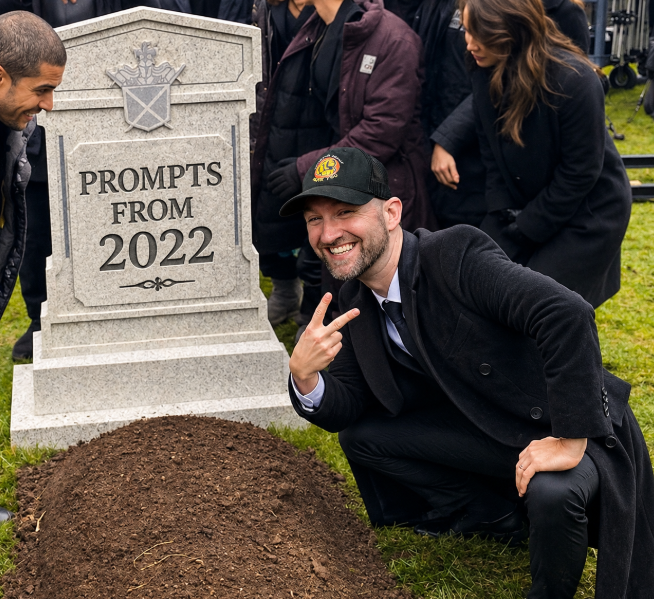
So maybe it’s time to bury the prompts from 2022. They served us well. We learned a lot. But we’re not in 2022 anymore.
🤘