Trust Me Bro Marketing







Using Satire as a Sandbox to Sanity-Check the Agency’s Own AI Systems
Challenge
- MANY was building AI-powered infrastructure, including automated blog publishing, an AI diagnostic funnel, and auto-posting cadences, that needed real-world stress testing, not just a staging environment.
- Testing new automation directly on client accounts carries real risk: a broken sync job or an off-brand AI output on a live client’s site is expensive to fix and worse to explain.
- The team needed a project with enough of a real identity to genuinely test brand-voice consistency at volume, without any of the consequences of a real client relationship.
Objectives
- Build and stress-test a full, two-part automated marketing pipeline — content engine plus lead capture, in a zero-risk environment.
- Validate that AI-generated content could auto-publish reliably on a schedule, end to end, with no manual babysitting.
- Sanity-check brand-voice guardrails by pushing them to a deliberately absurd extreme, where any drift or breakage is obvious immediately.
Solution & Implementation
A Real Brand, On Purpose
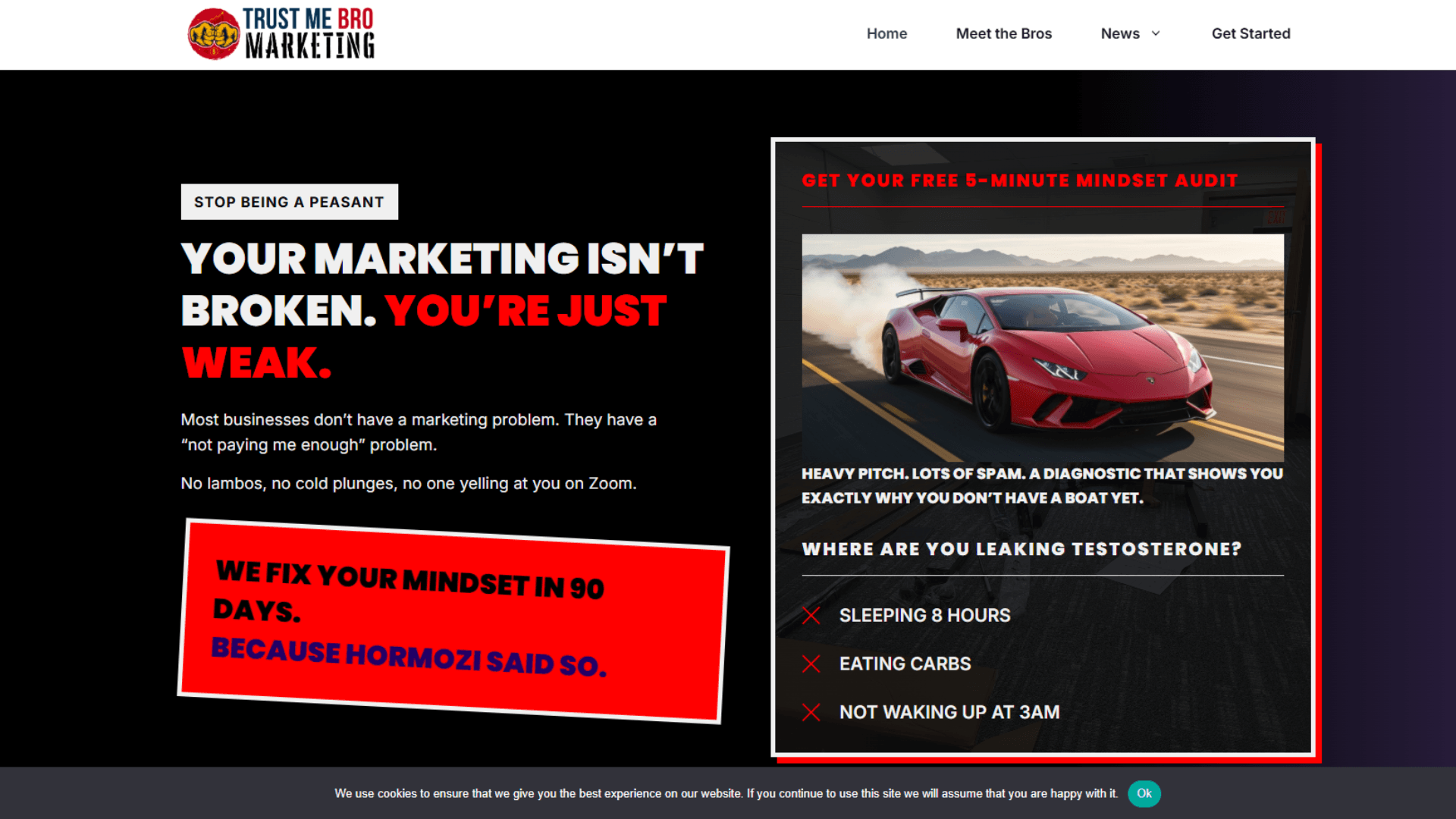
MANY built Trust Me Bro Marketing a full Brand Kit — color system (Alpha Crimson, Giga-Black, Testosterone Orange), typography rules, an “Approved Vocabulary Matrix” that translates plain agency language into aggressive guru-speak, and compliance-disclaimer copy. Giving the parody a real identity was the point: without a real brand to stay consistent with, there’s nothing meaningful to test.
Part 1: The Strategy Gap Detector (Frontend)
A React application at yourfreeplan.com that captures leads through a multi-step diagnostic funnel, crawls a submitted website in the background, and uses OpenAI to generate a personalized 5-step marketing plan with an ROI calculator. Every result pushes instantly into the CRM via webhook, tagged and mapped. This is the same diagnostic-funnel architecture intended for real client use — proven here first, including its fallback logic for when the AI call fails or times out.
Part 2: The Blog Publishing Pipeline (Backend Automation)
An automated content pipeline syncing articles from a Notion database straight to WordPress via GitHub Actions on a 2-hour cron schedule. Blog posts, including satirical “case files” like THE AGENTIC LIAR: TRUTHNODE™ and THE PHANTOM PAYROLL: GHOSTSTAFF™, are written in Notion, converted to HTML, and published automatically, with a hidden Notion page-ID comment preventing duplicate posts.
AI Auto-Posting at Full Volume
Running the satire brand through the real content pipeline, on a real cron schedule, at real publishing volume gave the team a genuine, low-stakes test bed for exactly the kind of automation failures that are expensive to discover on a client’s live site.
Results So Far
- A fully validated, end-to-end lead-capture-to-CRM pipeline (yourfreeplan.com) proven reliable before extension to paying clients.
- A working automated blog-sync pipeline (GitHub Actions → WordPress) running on a fixed cron schedule with duplicate-post protection.
- A documented, extreme-tone brand-voice guardrail system that makes any consistency drift immediately obvious.
Impact & Learnings
Satire makes an excellent QA sandbox. Because nothing is really on the line, the team can push automation, tone, and infrastructure hard enough to actually find the breaking points.
Prove the pipeline on something disposable first. The same diagnostic funnel and publishing automation now underpinning real client work were battle-tested here, at no risk to an actual client relationship.
Humor lowers the stakes enough to be honest about what’s broken. It’s easier to say “the sync job failed” about a parody blog than about a paying client’s site — which means problems get caught and fixed faster.