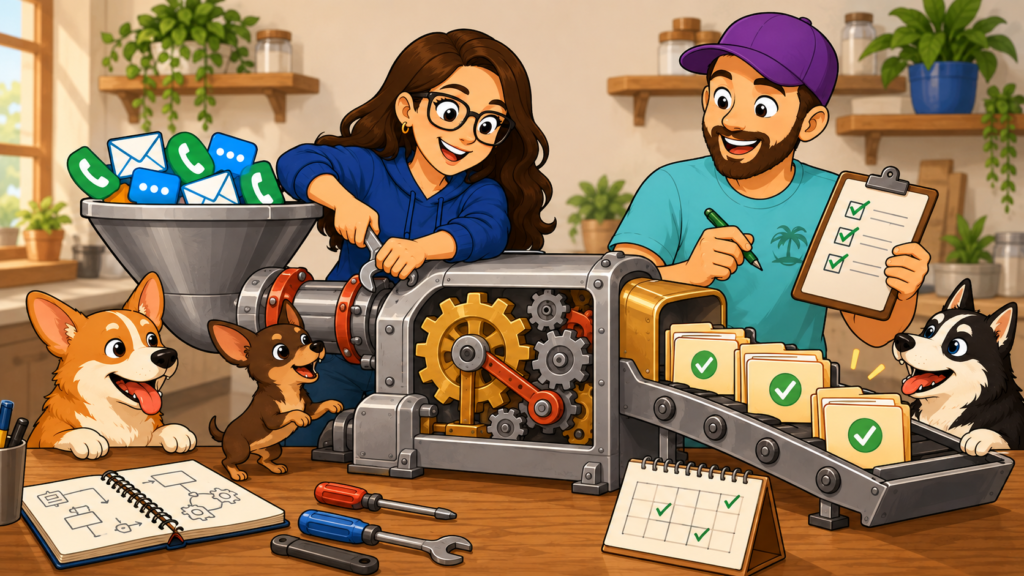
There was a theme that kept showing up for me throughout August, and it had less to do with any one platform or technology than it did with how much we’re starting to rely on systems we don’t completely control.
Google is making more decisions about where and how ads run. Meta is doing the same. AI is moving from helping us write things to actually doing things. WordPress sites continue to get more complicated behind the scenes. And in real estate, we’re seeing people run into the very human version of the same problem: assumptions don’t always match reality.
The common thread is control.
Not exactly the sexiest topic in marketing, but increasingly one of the most important.
The platforms are getting smarter. That doesn’t mean we should stop paying attention.
Google, Meta and the various AI-powered advertising tools are taking more decisions off the marketer’s plate. In theory, that’s a good thing. If the system has better data and a clear objective, automation can do things faster and at a scale that would be difficult to manage manually.
The problem comes when the system is optimizing toward something other than what the business actually wants.
If Google is optimizing toward cheap leads instead of good leads, it can do that incredibly efficiently. If Meta finds people who are great at clicking but terrible at becoming customers, it’ll happily find more of them.
That’s why conversion data matters so much.
A form fill isn’t necessarily a lead. A phone call isn’t necessarily a good prospect. A sale isn’t necessarily a good customer.
The platforms can only optimize based on the signals we give them.
So before changing a bidding strategy or throwing more money at a campaign, it makes sense to look at what’s actually being fed into the system. Are the conversion actions correct? Are calls being evaluated for quality? Are leads making it into the CRM? Are we connecting advertising activity to what happened after the initial conversion?
This is also why I’m increasingly less interested in looking at ROAS by itself. ROAS is useful, but it doesn’t tell the whole story. Margin, refunds, cancellations, customer quality, qualified leads and downstream revenue can tell you whether the thing the platform is calling a “conversion” actually created value for the business.
The dashboard can look great while the business result is mediocre.
That’s a problem.
AI is becoming more useful, which means the questions around it are getting bigger.
The AI conversation has changed quite a bit.
We’re moving past the simple “write me a blog post” use case and into AI handling recurring workflows, research, email, presentations, coding and connected data.
That’s where things get interesting.
It’s also where things get a little more complicated.
The more useful AI becomes, the more access we’re willing to give it. And that creates a new set of questions around permissions, memory and accountability.
What can it read? What can it remember? What can it change? What can it send? What can it publish? What happens when it gets something wrong?
“The AI did it” probably isn’t going to be a particularly satisfying explanation when something important goes sideways.
The same issue shows up in AI-generated research. A report can sound incredibly convincing and still contain incorrect information. That’s why source checking, claim verification and clearly separating supported findings from assumptions are becoming more important.
The goal isn’t to avoid AI.
The goal is to build workflows where you know what the AI is doing, what information it’s using and where a human needs to make the final call.
The website isn’t finished just because it looks good.
WordPress had its usual collection of security, plugin, theme, update and maintenance issues in August.
But there’s a bigger lesson in all of that.
A website isn’t really finished when it looks good. It’s finished when somebody can actually maintain it.
Who owns the licenses? Who has access? What happens when a plugin breaks? Is there a backup? Is there a staging environment? Can the client actually edit the content? Does anyone know what was custom coded six months ago?
Those questions aren’t particularly exciting during a website build.
They become very exciting when something breaks.
That’s why maintainability needs to be part of the conversation from the beginning, not something we worry about after the fact.
Real estate has its own version of the same problem.
I’ve also been paying attention to the conversations around real estate affordability and transaction risk.
One thing that stood out is how often the question isn’t really whether someone can qualify for a mortgage.
It’s whether they can comfortably live with the payment after they close.
Those are two very different questions.
Mortgage payment, PMI, childcare, repairs, emergency reserves and liquidity all matter. Getting approved doesn’t necessarily mean the purchase is comfortable.
On the transaction side, we’re seeing plenty of situations where assumptions run into actual procedures. Title issues, occupancy, divorce, inheritance, deposits, inspections, seller cash shortfalls and lease issues can all create problems when someone assumes the process works one way and the actual process works another.
A lot of risk comes from things that weren’t documented, verified or communicated clearly enough.
So what does all of this have in common?
For me, August wasn’t really about Google, Meta, AI, WordPress or real estate individually.
It was about operational maturity.
We’re using more systems. We’re automating more things. We’re connecting more data. We’re asking technology to make more decisions for us.
That means we need better controls around all of it.
Cleaner data. Clearer permissions. Documented processes. Better reporting. More verification. And metrics that connect activity to what actually matters to the business.
The technology is getting more complicated.
Our job shouldn’t be to make the client understand all of that complexity.
Our job should be to understand it well enough to make the next decision simple.
That’s probably the biggest thing I’m taking from August.
The platforms are going to keep changing. The AI tools are going to keep getting smarter. The software is going to keep updating.
That’s not going to stop.
The advantage isn’t necessarily knowing every new feature the day it comes out.
It’s having good enough systems to know when something changed, whether it matters, and what the hell to do about it.