“Here’s what I did.”
It sounds useful. It sounds credible. It sounds like someone is about to hand you the playbook.
Except . . .
It isn’t strong enough anymore and it hasn’t been for a long time.
I am tired of watching gurus sit on rotting laurels, hiding behind a heavy dose of rosy retrospect. They love to take you back to 2019. Back when ad costs were cheaper, organic reach actually meant something, and you could throw a few hundred bucks at Facebook, make a decent offer, and suddenly look like a marketing genius.
They will walk you through the campaign, show you the screenshots, talk about the revenue, and maybe even drop some Stripe notifications. Then comes the implied conclusion: do what I did and you can get what I got.
That is where I call bullshit.
Not because the result wasn’t real. It might have been completely real. That is actually what makes this whole thing so dangerous. The problem isn’t that they are lying. The problem is that they are telling you the truth about something that may no longer be true.
“I created a six-figure infoproduct.”
It sounds impressive on a slide deck. It gets a nice little cluster of applause in a hotel ballroom.
Except . . .
When you look under the hood, the math tells a totally different story.
I see these guys online all the time. They are out here shouting about how they “exited three businesses,” but they are also rabidly posting on LinkedIn five times a day, trying to sell a $997 course on how to achieve financial freedom.
Here is the quiet part they leave out of the keynote.
(Hint . . . you didn’t build a massive empire. You just had your current solopreneur business “buy” your wantrepreneur business.)
The Circular Economy of the Info-Guru
It is a neat little magic trick.
You start a digital agency or a consulting gig. It makes some steady cash flow. Then, you realize it is a lot easier to sell the dream of escaping the grind than it is to actually do the hard, unsexy daily labor of running operations for clients.
So you package up your rough notes into a masterclass. Who buys it? Desperate beginners. Who promotes it? Other guys running the exact same playbook.
And your own businesses? They just shuffle money around. Your agency buys the software, pays the software affiliate commission back to your holding company, and funds the ad spend to acquire leads for the info-product. On paper, it looks like a portfolio of thriving exits. In reality, it is just a closed loop of self-funding vanity.
That is not an exit. That is a shell game.
Your Past Is Not Today’s Market
A tactic can work brilliantly under one set of conditions and become completely useless under another. Different audience, different offer, different competition, different platform economics, different buying behavior. Same tactic, totally different outcome.
That is why “here’s what I did” is such a weak form of advice. It gives you an answer without giving you the conditions that made the answer work. Without those conditions, you are not getting a strategy. You are getting a story.
Stories are great. They just are not operating systems.
I have watched businesses make this mistake on a loop. Someone tells them to run a specific ad, so they run the ad. Someone says post five times a day, so they start posting. Someone says webinars are the secret, so they spend a month building a webinar. Everyone has screenshots, a testimonial, or a case study.
Yet the business owner is still sitting there with a broken pipeline, no clean handoff, and a CRM full of dead contacts nobody is touching.
That is not a tactics problem. That is an architecture problem.
Proof Matters. But Proof Isn’t Enough.
Let me be clear. I am not anti-case-study. I am not anti-testimonial. Quite the opposite. Proof matters. A lot.
If someone tells you they can do something, you should want to know whether they have actually done it. But there is a massive difference between proof that something happened and understanding why it happened.
Anyone can cherry-pick a winner from a fluke campaign and slap it on a landing page. That is why I built the BS detector for this exact reason. If you cannot look under the hood and explain the mechanics of how it happened, a testimonial is just expensive wallpaper. It might make your website look slick, but it does not make the strategy transferable.
That is the actual shift you need to look for:
Stop asking what someone did back then. Start asking: “Here is what I will do for you, how and why, because I’ve actually done it for someone else lately.”
Random Actions Don’t Compound
When things slow down, businesses usually respond by adding more activity. More posts, more ads, more emails, more software, more dashboards.
Activity does not automatically create momentum. Sometimes it just creates more places for things to break. If your positioning is messy, more traffic just gives you more confused visitors. If your CRM is a disaster, more lead generation just gives you a bigger pile of leads to ignore.
Everything has to connect. That is what strategy actually means to me. Not a forty-page PDF or a bunch of colored boxes. It is deciding what matters, what doesn’t, what happens first, what happens next, who owns it, and how we measure it.
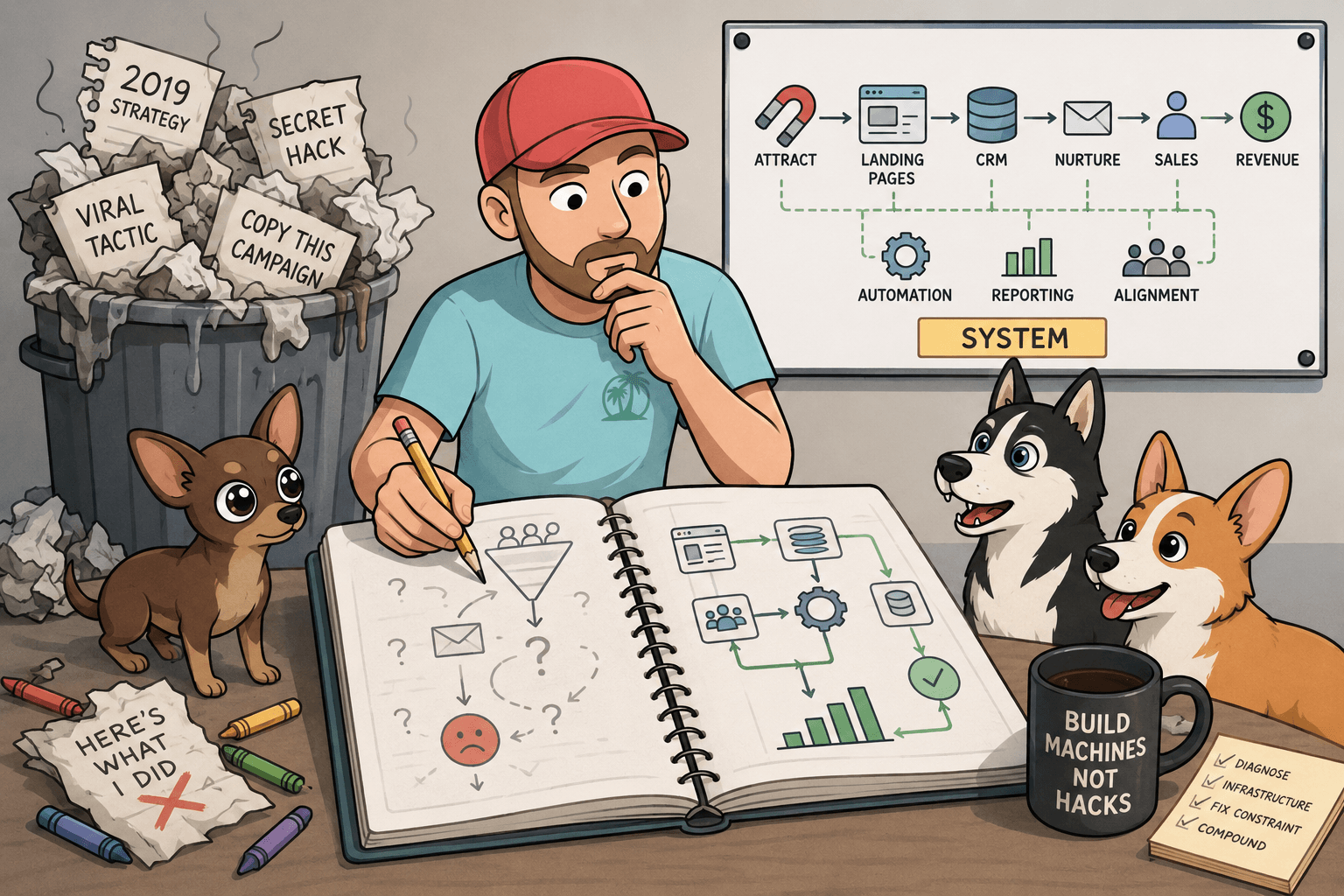
Random actions don’t compound. Systems do. We build machines, not hacks.
Stop buying the nostalgic fairy tales, the circular info-products, and the secret formulas from five years ago. Build the architecture that actually scales.