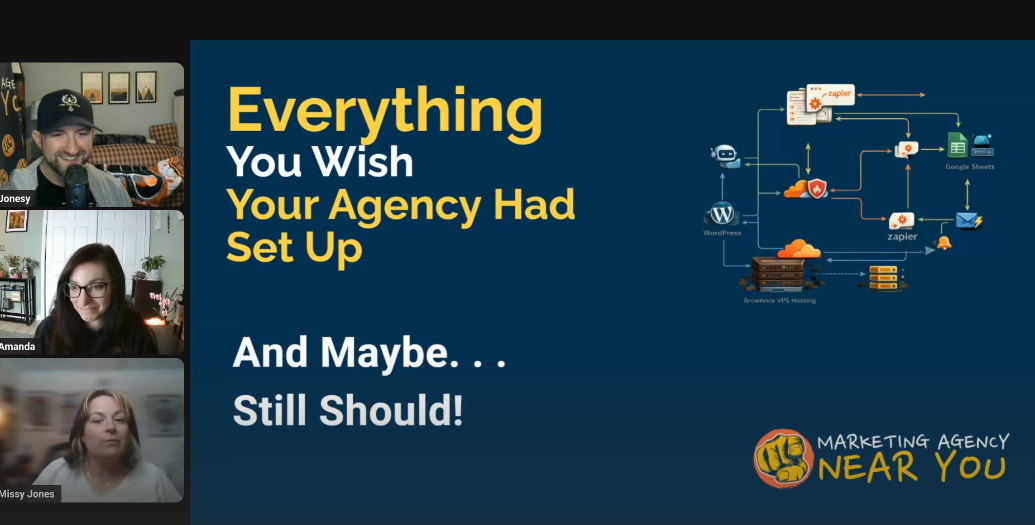
Five minutes into our presentation — Everything You Wish Your Agency Had Set Up (And Probably Still Should) — Facebook killed one of our streams.
No warning.
Just dropped it.
We were mid-slide. Talking through infrastructure. Explaining redundancy. Showing the stack. Comments were coming in. Engagement was solid.
And then one distribution path disappeared.
Here’s the part that mattered.
We didn’t stop.
Because we weren’t streaming in one place.
We were streaming to our landing page at the same time.
Separate channel. Separate path. Separate control.
The presentation continued.
No scrambling. No apology spiral. No “give us a second while we figure this out.”
It just kept going.
And that moment perfectly illustrated the entire thesis of the presentation.
Assume the tech will fail.
Because eventually, it will.
The Illusion of Stability
Most small businesses believe they have a marketing system.
What they actually have is a collection of tools.
From the outside, everything looks fine.
The website loads.
Ads are running.
Leads come in.
Emails send.
But the moment you start tracing the path — from traffic to form to CRM to follow-up — the certainty disappears.
Where does the form actually go?
Who gets notified?
Is the CRM tagging correctly?
Is email authentication even configured properly?
Is the domain owned by the business — or by a former contractor?
I’ve logged into accounts where the domain was expiring in three days and nobody on the team knew who controlled it.
That’s not a marketing issue.
That’s structural fragility.
One Is None
There’s an old IT principle:
One is none. Two is one.
If you only have one version of something, you effectively have zero.
One stream.
One hosting provider.
One admin login.
One email notification.
One ad account tied to someone’s personal profile.
Everything looks stable until one layer fails.
And when it fails, you realize you didn’t have a system.
You had a single point of failure.
When Facebook dropped that stream, nothing broke.
Because we didn’t depend on one path.
Most businesses do.
Convenience Is Not Architecture
It’s easy to bundle everything together.
Register the domain where you host the site.
Run email from the same provider.
Build the site inside the same ecosystem that runs the ads.
It feels clean.
Until something goes wrong and you don’t know which layer failed.
Was it DNS?
Was it hosting?
Was it the registrar?
Was it email authentication?
When everything lives in one place, diagnosis becomes guesswork.
When systems are separated intentionally, failures are isolated quickly.
Separation isn’t complexity.
It’s control.
Attribution Quietly Leaks Too
Another hidden fragility is attribution.
Meta says you generated 40 leads.
Google says 32.
Your CRM shows 45 total.
Somewhere, math stopped mathing.
Platforms grade their own homework.
That’s why we layer tracking.
Forms log entries independently.
CRM captures and tags them.
Notifications fire immediately.
Redundant logs validate capture.
Analytics verifies traffic.
Behavior tools show engagement.
If something spikes, we don’t assume.
We investigate.
Was it seasonality?
Was it content?
Was it an external event?
Was it noise?
Emotion doesn’t belong in diagnosis.
Structure does.
Creativity Doesn’t Save Broken Systems
Agencies love to talk about creativity.
And creativity matters.
But resilience matters more.
If a lead comes in, we want:
• The form logged
• The CRM updated
• A primary notification sent
• A backup notification sent
• A redundant validation recorded
Is that overkill?
Until one automation fails silently and you don’t lose a $15,000 opportunity because you engineered redundancy.
Redundancy isn’t paranoia.
It’s professionalism.
AI Won’t Fix Chaos
We use AI constantly.
But AI amplifies structure.
If your tracking is broken, your insights will be broken.
If your CRM stages are sloppy, your forecasting will be fantasy.
Clean inputs produce clarity.
Messy systems produce confident nonsense.
Build Like It Will Break
Your website will break at some point.
An integration will fail.
An ad account will get flagged.
A login will get lost.
That’s not dramatic.
That’s business.
The real question is not whether failure happens.
It’s whether your business collapses when it does.
When Facebook killed our stream, it wasn’t a crisis.
It was confirmation.
The stack held.
The system absorbed the hit.
That’s the difference between something that performs…
…and something that endures.
Hope is not infrastructure.
Architecture is.
And the market rewards the businesses that are built to survive the glitch.