Why do so many businesses set fire to their marketing budget?
It usually isn’t because they’re bad at what they do. It isn’t because they picked the wrong channel or didn’t post enough on social media.
Most of the time, they just believed a pitch they never should have believed.
A bold promise. A flashy stat. A testimonial that conveniently lacks a name. A guarantee that sounds too good to be true. By the time they figure out the claim wasn’t actually grounded in reality, the cash is gone and they’re back to square one.
Marketing has a massive trust problem. It is way too easy to throw up a site and claim you doubled leads in 30 days or that your AI is going to replace a whole department. Maybe some of that is true. Maybe some of it is technically true but leaves out the part where they spent a fortune on ad spend to get those results.
The problem isn’t that bold claims exist. The problem is that most people don’t have a way to filter them.
Confidence is not evidence.
The loudest person in the room is usually the one who sounds the most convincing. A polished presentation can make almost any lie feel like a safe bet. But high production value doesn’t make a claim true.
Every single marketing claim needs receipts.
If you hired a contractor to build your house and they told you they could do it twice as fast as everyone else, you wouldn’t care about their logo or how slick their brochure was. You’d ask questions. How? Can I see your other jobs? What happens if it doesn’t work?
For some reason, when people buy marketing, they stop asking those questions. They just buy the confidence.
Over time, we stopped relying on gut feeling and built a simple framework to evaluate these claims. Whenever someone promises the moon, we put it through the wringer.
- Is the claim specific? Vague stuff like “explosive growth” is just noise. “37% increase in qualified leads over six months” is something you can actually check.
- Does the math work? If the numbers don’t add up, walk away. Good marketing has to obey basic math.
- Can you verify the proof? Testimonials need names. Case studies need a process. If you can’t find proof anywhere other than their own sales page, it isn’t proof.
- Who gains from you believing it? Everyone is selling something, but are they being transparent about the incentive?
- Is this the standard or the exception? A one-off miracle result isn’t a strategy.
- Can this be replicated? If it only works because of a unique situation or a massive budget, it probably won’t work for you.
- Do they have a real track record? Do their actions actually match their talk?
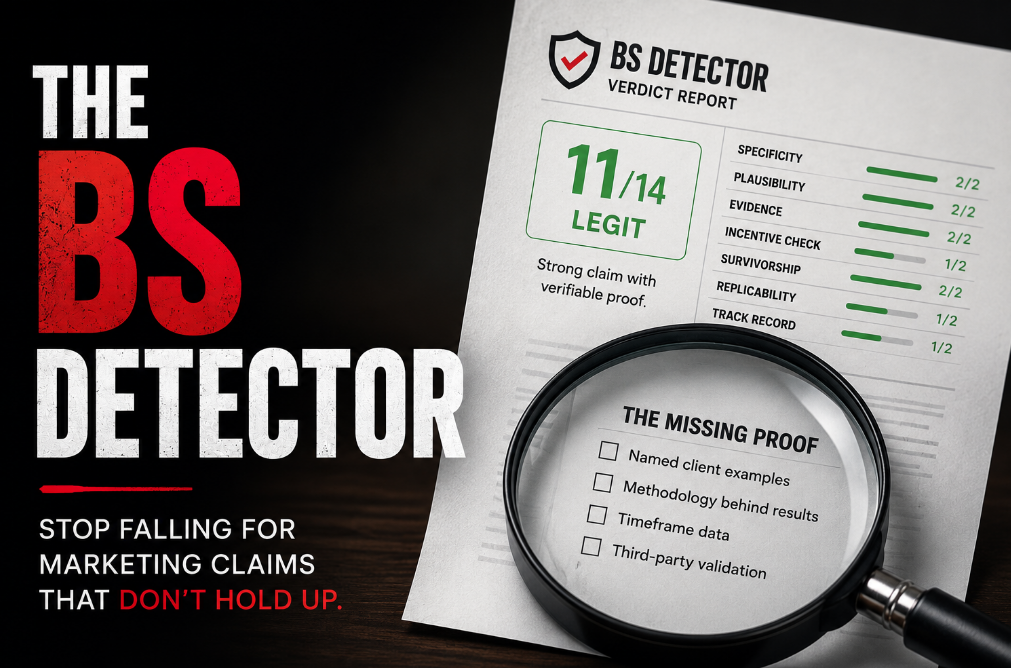
We got tired of watching people get burned, so we turned this framework into a tool: The BS Detector.
It doesn’t tell you what to buy. It just forces the conversation to move from “is this person cool?” to “what is the actual evidence here?”
We aren’t trying to make anyone cynical. There are great marketers out there who deliver real results. But those people won’t mind if you ask a few questions. They will usually welcome it because their work holds up under scrutiny.
If asking a few reasonable questions causes the whole pitch to fall apart, you just saved yourself a lot of time and money.
Before you sign that next contract, stop. Take five minutes. Run the numbers.
Go to https://bs.yourfreeplan.com to protect your budget, and keep your business out of the weeds.