Why Your Past Success Might Be Masking a Future Problem
Most businesses don’t collapse in a dramatic moment.
They fade.
Quietly.
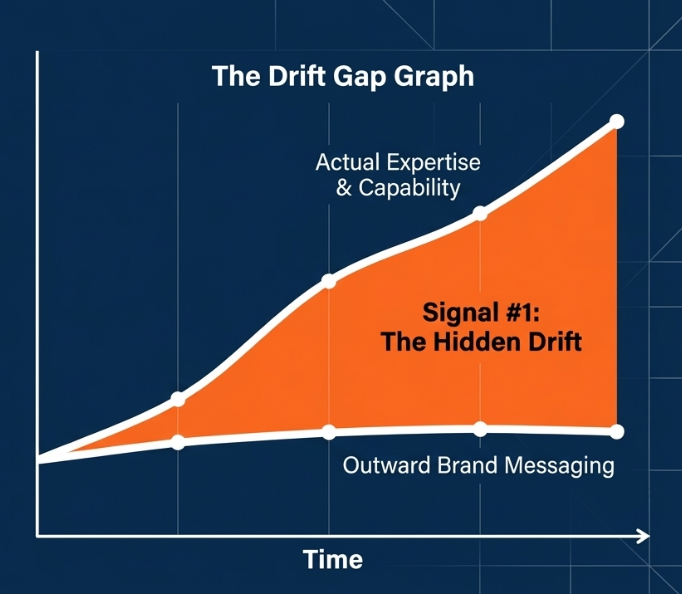
Not because they got worse, but because they got better and never updated how they show up. The real issue isn’t performance. It’s misalignment. Your expertise evolves, your thinking sharpens, your capabilities expand… but your messaging stays stuck in an earlier version of you.
That gap is where authority starts to erode.
You’re not failing. You’re just ghosting your future self.
The hidden gap between what you are and what people see
Professional expertise is not static. It compounds. It evolves with every client, every project, every lesson learned. But messaging rarely keeps pace. Most businesses update their skills far more often than they update their positioning.
So a gap forms.
Internally, you’re operating at a higher level. Externally, the market still sees an outdated version of you. At first, this just creates mild confusion. Over time, it becomes something more serious… a slow erosion of authority that often goes unnoticed until it starts affecting the quality of opportunities coming your way.
Why revenue gives you false confidence
One of the most misleading signals in business is steady revenue.
It feels like validation. It suggests that everything is working. But revenue is a lagging indicator. You can continue to generate income based on past reputation while your current positioning is quietly drifting out of relevance.
In high-trust industries especially, momentum carries weight. Relationships, referrals, and prior credibility can sustain you longer than your positioning deserves. But that creates a dangerous illusion.
By the time revenue dips, the underlying issue has already compounded. What looks like a sudden slowdown is usually the result of years of unnoticed drift.
The success cage
Past success has a way of becoming a constraint.
What once worked becomes what you defend. The specialties that built your reputation, the clients that validated your early growth, the markets that gave you traction… they start to define you.
Even when you’ve outgrown them.
This is the success cage. It shows up when your brand continues to reflect who you were instead of who you’ve become. You keep speaking to a version of the market you no longer belong to, attracting clients you’ve already surpassed, reinforcing a narrative that limits your next level of growth.
It feels like consistency. In reality, it’s stagnation.
The visibility trap
When growth slows, the instinct is to increase activity.
More content. More ads. More outreach. More visibility.
But visibility without relevance is not a solution. It’s an amplifier. If your positioning is misaligned, more exposure simply spreads the misalignment further.
This is why some businesses can be everywhere and still struggle to convert at the level they expect. The issue isn’t attention. It’s clarity. Without a precise signal, increased visibility becomes noise.
Credentials are no longer the differentiator
There was a time when experience, certifications, and credentials were enough to establish authority.
That’s no longer the case.
Today, those things are expected. They are the baseline, not the differentiator. Authority now comes from perspective… how you interpret problems, how you frame solutions, how you think in ways that others don’t.
Two people can have identical credentials. The one with a sharper, more distinct point of view will command more attention, more trust, and ultimately, higher value.
When sales friction is actually a positioning problem
Many businesses misdiagnose their sales challenges.
Longer decision cycles get blamed on cautious buyers. Pricing resistance gets attributed to budget constraints. The need to “educate” prospects gets framed as part of the process.
But these are often symptoms of a deeper issue.
When your positioning is clear, prospects arrive with context. They understand what you do, why it matters, and where you fit. The conversation becomes about execution, not explanation.
When positioning is unclear, every interaction becomes uphill. You spend time justifying your value instead of delivering it.
Sales friction is rarely a sales problem. It’s usually a positioning problem.
A simple way to assess where you stand
If you step back and look objectively, a few questions can reveal a lot:
Has your expertise evolved faster than your messaging?
Does your brand still reflect an earlier version of you?
Are you attracting clients you’ve already outgrown?
Is your sales process taking longer than it should?
Are you relying on credentials instead of perspective to differentiate?
If several of these resonate, it’s not random. It’s a pattern.
Realignment doesn’t require a rebuild
Fixing this doesn’t mean starting over.
It’s not about a full rebrand or a complete overhaul. In most cases, the shift comes from refining a few key touchpoints… the places where people form their first impression.
Your homepage headline.
Your LinkedIn positioning.
Your “About” narrative.
Your service descriptions.
These are leverage points. Small changes here can create a disproportionate shift in how the market perceives you.
The goal is alignment. Closing the gap between what you are and how you show up.
The bigger picture
At its core, positioning is about building a bridge.
A clear line from where you started to where you are now. When that bridge is visible, the market doesn’t have to guess. People see you accurately. They understand your value faster. They trust you more easily.
And when that happens, everything downstream improves. Shorter sales cycles. Better-fit clients. Less price sensitivity. More precise referrals.
The question is simple.
Is your brand a reflection of who you were a few years ago… or a signal for the clients you’re meant to serve now?
If you want a clearer answer
We built a simple test to help you see where you actually stand.
It takes a few minutes and gives you a direct read on whether you’re aligned or drifting.
Try it here: https://quiz.manyresults.com
If something feels off after you go through it, that’s not a bad thing.
That’s the signal.